
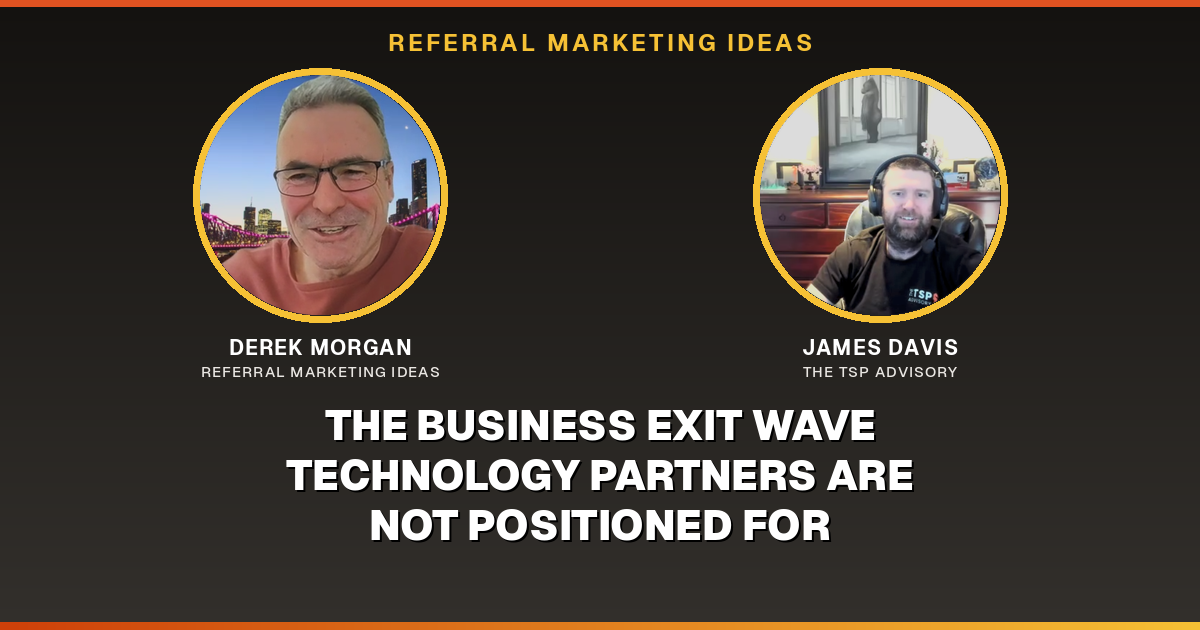
The business exit wave technology partners are not positioned for
Almost half of Australia's Baby Boomer business owners plan to exit within five years. James Davis of The TSP Advisory on why technology partners need referral relationships with the advisors already in those exit conversations.
Almost half of Australia's Baby Boomer business owners plan to exit their business within the next one to five years, according to MYOB's Bi-Annual Business Monitor. That is not a slow drift. It is a structural shift moving through the client base of every technology partner, accountant and advisor who serves small and mid-sized business, whether they have noticed it yet or not.
I talked this through with James Davis, founder and chief strategy officer of The TSP Advisory, who has spent more than fifteen years advising managed service providers and technology solutions partners across the APAC region. His read on the shift is blunt: a business preparing to exit stops investing in its future, because the owner is no longer thinking about the future. That is a direct threat to any technology partner whose value proposition is built on being the trusted long-term supplier. The client is not leaving because the relationship soured. The client is leaving because the business itself is ending, being sold, or being absorbed into something larger.
Client churn like this does not show up as a competitive loss. It shows up as a business simply changing shape underneath a relationship that assumed it would stay the same. And it is compounding with two other forces at once: larger, better-funded players moving into the same market and commoditising price, and a generational handover in which the next owner often expects a different kind of relationship than the one their predecessor had.
The comfortable local relationship is not the moat it used to be
For a long time, the smaller MSP or technology partner had a genuine advantage: proximity and trust. The client did not understand the technology and needed someone local they could rely on. That advantage is eroding. Newer owners run more collaborative businesses and expect partners to prove value continuously rather than coast on tenure. A twenty-year relationship built on familiarity is a different asset than a twenty-year relationship built on demonstrated value, and only one of those survives a change in ownership.
The same erosion is happening to where technology partners find new clients in the first place. Most built their networks out of an existing circle: past clients, friends, people met at the same local events. That circle has not disappeared, but it has stopped producing the way it used to, because the businesses inside it are the same ones now exiting or changing hands.
A referral relationship and network built entirely on ad hoc referrals and cold outreach is exposed.
Where the real opportunity sits
Here is the part worth sitting with. A business preparing to exit is already surrounded by people actively involved in that transition: accountants, financial planners, business brokers, lawyers. These are not incidental contacts. They are, right now, having the conversations that determine whether that business invests in anything, including technology, before it changes hands.
That is a direct description of what the Referral Marketing Formula™ focuses on in RMF Module 2: Ideal Referral Partner Profile Builder.
The question is not who likes you. It is who already has trusted, regular access to the exact businesses you want to reach, at the exact moment those businesses are making decisions that matter. An accountant preparing a client for sale, a financial planner factoring in sale proceeds into a retirement plan, or a broker running the numbers on an acquisition, sits closer to that decision than almost any marketing channel a technology partner could build from scratch.
The businesses moving the other way through this cycle, the newer, smaller and emerging companies picking up where an exiting business leaves off, need the same kind of thinking in reverse. They are underserved, because most technology partners have spent years moving upmarket and no longer chase small accounts. A technology partner willing to work with a business before it is established, the way they might have a decade ago, gets first access to companies that will eventually outgrow them, and a genuine head start over competitors who only show up once a business is already a target worth fighting over.
Positioning has to survive contact with a specific person
None of this works if the underlying positioning is generic. A recurring theme in the conversation was how many technology partners describe themselves in terms so broad that a prospect cannot tell them apart from their competitors. Everyone claims the same partners, the same outcomes, the same commitment to service. That kind of positioning does not just fail to convert. It actively wastes the access a strong referral partner relationship and network could otherwise provide, because the introduction lands and nobody can explain why it matters.
The fix is not a bigger claim. It is specificity: a clear point of view on who you serve, what outcome you actually deliver, and a willingness to say plainly who you are not the right fit for. A technology partner who can tell an accountant exactly what a good referral looks like, in language that accountant can repeat accurately when the technology partner is not in the room, gets far more out of that relationship than one who hands over a generic pitch deck and hopes.
AI is making this problem worse, not better. It has lowered the barrier to sounding competent, which means the average level of competing content and positioning has moved up while the number of businesses saying something genuinely distinct has not.
If that sounds like bad news for a technology partner trying to stand out in a crowded middle, it is. But it also means a partner with a real point of view, said plainly, cuts through more easily than it used to, precisely because most of what surrounds it now reads the same. Noise raises the floor. It does not raise the ceiling.
Build the referral partner relationship on value, not commission
The instinct with any new partnership is to ask how to monetise it. That instinct, left unchecked, tends to weaken the relationship rather than strengthen it. A partnership that opens with a commission conversation signals that the value on offer is thin enough to need a direct financial incentive to justify itself.
A partnership built around genuinely useful core business value for a referral partner, delivered without a running tally of who owes whom, tends to produce faster engagement, more referrals and far more partner and client retention over time, and it scales in a way commission-first relationships usually do not, because it is not capped by what either side can afford to pay out.
This lines up closely with RMF Module 4: Partner Program Builder, which treats the type of partnership as a deliberate choice rather than a default. A referral partner relationship built on shared value, where the technology partner becomes genuinely useful to what a referral partner is trying to achieve for their own clients, holds up in a way a pure lead-swap arrangement does not, particularly once the market shifts underneath both parties, which is exactly what is happening now.
Useful, in this context, does not have to mean complicated.
For example, it can be as direct as helping a business coach or business broker understand what a genuinely strong technology setup looks like when they are helping plan a business exit or assessing a business for sale, or helping an accountant flag a client whose ageing systems are quietly capping their exit valuation before it becomes a problem in due diligence. Neither of those requires a commission structure. Both make the technology partner someone worth calling early, which is the entire point of building the relationship in the first place.
Common questions
Why does business ownership turnover matter to technology partners specifically?
A business planning to exit or change hands typically stops investing in anything with a payback period longer than the sale itself, including technology. That directly affects any partner whose model depends on ongoing investment from an existing client base, and it means client churn from ownership change can look identical to a lost deal without ever showing up as one.
Who should a technology partner be building referral partner relationships with, given this shift?
The people already involved in a business's growth strategies, exit planning or ownership change: accountants, financial planners, business brokers, business coaches, fractional consultants and lawyers. They have trusted, regular access to the businesses going through this transition well before a technology partner would otherwise hear about it.
Is this only relevant to businesses that are actively selling?
No. The same shift creates opportunity on the other side, with newer and smaller businesses that traditional technology partners have moved away from serving as they chased larger accounts. A partner willing to work with those businesses early gets a head start most competitors are not positioned to match.
Should referral partnerships with advisors like accountants be commission based?
Not by default. A partnership built on genuinely useful value tends to outproduce and outlast one built primarily around a commission arrangement, particularly because it is not limited by what either side can afford to pay out and it holds up better when market conditions shift.
Using Refer2u
Knowing who should be in your referral partner relationships and network is one problem. Actually building and managing those relationships at scale is another. Refer2u, the Referral Partner Ecosystem, is built to help technology partners and the advisors around their ideal customers identify each other, define what a good introduction looks like, and keep that relationship active rather than letting it go quiet the way most professional relationships eventually do.
Does your own client base look like it is about to shift under you? Reply or comment and let us know how you are thinking about it.
James Davis is the founder and chief strategy officer of The TSP Advisory, where he works with managed service providers and technology solutions partners across the APAC region. You can follow his thinking on LinkedIn or find more of his work at thetspadvisory.com.
Ready to build your referral system? Read the Referral Marketing Formula™, explore our services, read the FAQ, or get in touch.
Related articles

How to identify and recruit ideal referral partners
The partners who send you the best leads are rarely the loudest in the room. Learn how to spot complementary businesses and start conversations that convert.

5 referral partner activation mistakes B2B teams make
You signed the partner. Then nothing happened. These five common errors explain why referral programs stall, and what to do instead.

The $44 million referral opportunity nobody followed up on
A single introduction that was never followed up cost one technology company an estimated $44 million over two years. Here is what unidentified opportunity cost looks like when nobody tracks what happens after the room agrees the fit makes sense.